
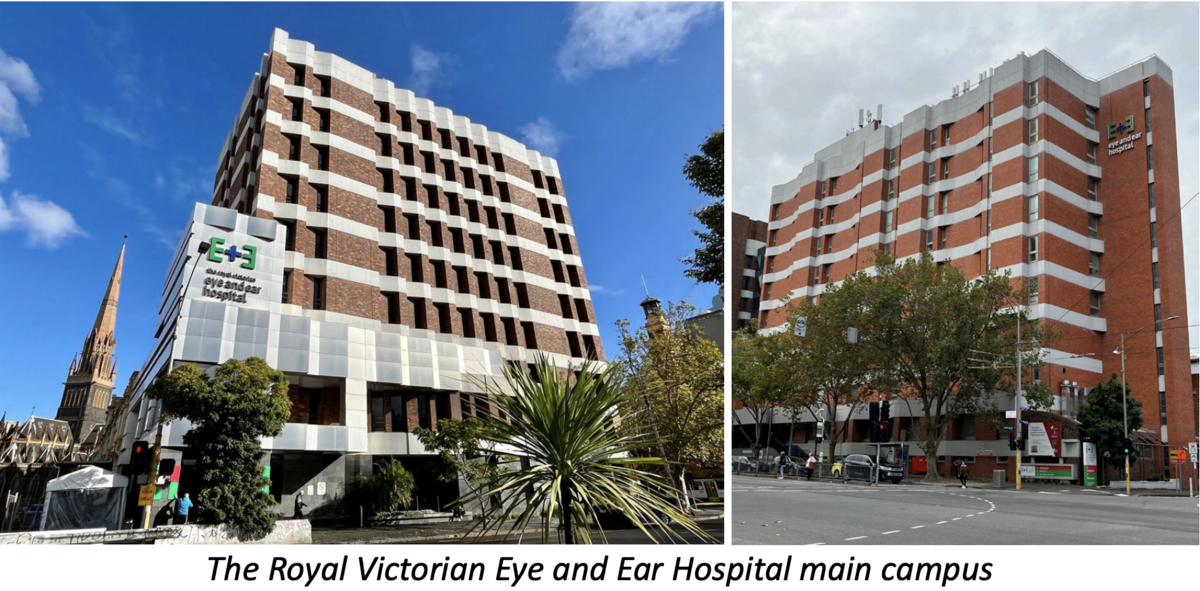
For my elective, I spent six weeks in the Ophthalmology department at The Royal Victorian
Eye and Ear Hospital in Melbourne, Australia. This is a specialist public teaching hospital for
Ophthalmology and ENT that provides services across the state of Victoria. Having
thoroughly enjoyed my Ophthalmology placement during medical school, my primary goal
of my elective was to gain further exposure in the specialty, to confirm whether I wish to
purse a career in Ophthalmology. I also wished to see how the healthcare systems and life as a doctor in Australia compared to the UK.
During my elective, I spent time in a variety of general and specialist ophthalmic clinics,
including the Acute Ophthalmology Service, theatres, and the Emergency Department,
where I was warmly welcomed by all teams. In the wide range of specialist clinics, such as
corneal, ocular immunology, glaucoma, neuro-ophthalmology and oculoplastics clinics, I was able to see a wide range of both common and rare ophthalmic conditions and genetic
syndromes, including corneal dystrophies, congenital rubella syndrome and iridocorneal
endothelial (ICE) syndrome. Unlike the Ophthalmology clinics I have attended in the UK,
clinics were run by several consultants, who were able to share expert opinions and
collaborate to formulate management plans for complex cases. The consultants spent lots of time teaching me and gave me the opportunity to examine the majority of patients myself using the slit lamp, which I was really grateful for. I was surprised at how similar the
healthcare systems are in Australia and the UK, both having public and private systems. And similarly to my experience in London, the patient demographics in Melbourne were very diverse; I met patients from a huge range of nationalities, backgrounds and ethnicities, many of whom required interpreters.
I also attended several theatres, including cataract, cornea, vitreoretinal and general
teaching lists. I was surprised to learn that pterygium removal was considered a general
operation in Australia (unlike in the UK), which all trainees learned to perform, due to the
high prevalence of pterygium caused by the increased UV exposure. It was in theatres that I met Ophthalmology trainees who were at the start of their training, from whom I received
valuable mentorship and portfolio advice. One of my favourite experiences was spending
time in the Emergency Department, where the registrars allowed me to see my own
patients. It was here that I was able to build my confidence in ophthalmic history-taking,
examination using the slit lamp and formulating differential diagnoses. I learned to
administer eye drops, invert eyelids, examine using fluorescein dye and use equipment such as the Hertel exophthalmometer. I saw patients with corneal ulcers and abrasions, subtarsal and corneal foreign bodies, eyelid lesions such as chalazions, cranial nerve palsies and giant cell arteritis. I am sure this experience will be really valuable for starting Ophthalmology training in the UK.
At weekends I was really grateful to be able to explore the beautiful state of Victoria,
including trips to Phillip Island and the Great Ocean Road. I was also keen to see the large
and vibrant Jewish community in Melbourne. I atended East Melbourne Chabad for Friday
night dinner, and visited family friends for Seder nights – I was amazed by the warmth and
hospitality of the community, and to know that I could experience a home away from home on the other side of the world.
To summarise, my elective in Melbourne has solidified my decision to pursue a career in
Ophthalmology. I received brilliant teaching and exposure to the specialty in a welcoming
and supportive learning environment, and saw conditions I would not have otherwise seen
during my Ophthalmology placement in medical school. I would highly recommend an
elective at The Royal Victorian Eye and Ear Hospital to students considering a career in
Ophthalmology. I am hugely grateful for the financial support of the Jewish Medical
Association, UCL and The Lord Mayor’s 800th Anniversary Awards Trust, which helped to
make this unique elective experience possible.
Jessica Mendall
University College London


